Job Openings at 7.5 Million in September: What It Means for Your Search
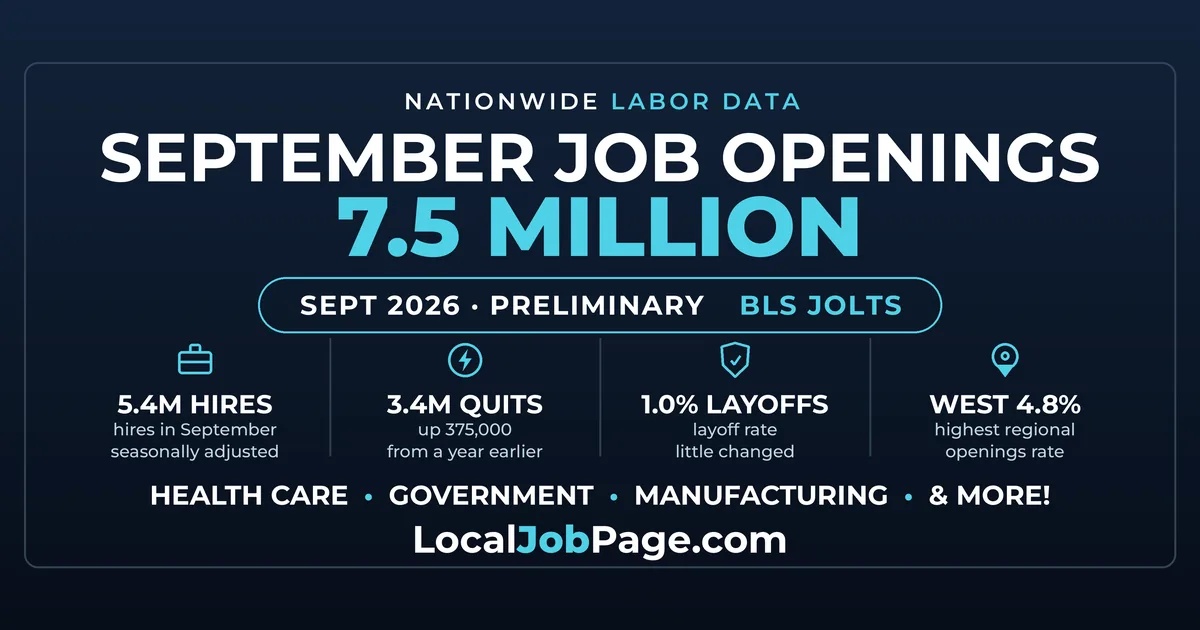
NATIONWIDE — U.S. employers had 7.5 million job openings on the last business day of September, according to the Job Openings and Labor Turnover Survey the Bureau of Labor Statistics released this morning. BLS called that little changed from August. Hires held at 5.4 million, layoffs stayed low, and quits rose to 3.4 million. For job seekers, the September job openings numbers point to a market that is still hiring steadily, with government, restaurants and the West showing the most movement.
September job openings came in at 7.5 million, hires at 5.4 million and quits at 3.4 million, with state and local government posting the one significant jump in openings and restaurants leading hiring.
Need work now? Skip straight to the job links and begin searching now →
📊 What the September Job Openings Numbers Say
All figures below are seasonally adjusted. The September numbers are preliminary and BLS will revise them next month.
- Job openings: 7.5 million, a rate of 4.5 percent, little changed over the month.
- Hires: 5.4 million, a rate of 3.4 percent, little changed.
- Quits: 3.4 million, up over the month, with the rate little changed at 2.1 percent.
- Layoffs and discharges: 1.6 million, a rate of 1.0 percent, little changed.
August was revised up. BLS now puts August openings at 7.2 million, 111,000 higher than first reported. A year earlier, in September 2025, openings stood at about 7.2 million and the openings rate was 4.3 percent, so September 2026 sits slightly above that mark.
The quits number is the one to notice. BLS said quits rose by 375,000 over the year. People leave jobs when they think they can land another one, so more quits usually means more confidence among workers, and every quit leaves a vacancy behind it. The layoff rate held at 1.0 percent, which means roughly one worker in a hundred was laid off or discharged in September.
How Many Openings Per Job Seeker
The September Employment Situation report counted 7.1 million unemployed people, seasonally adjusted. Set against 7.5 million openings, that is a little more than one opening per unemployed person. That ratio is our arithmetic and it combines two different BLS surveys, so treat it as a rough gauge. It still tells you something useful: there are about as many posted jobs as there are people looking, so a targeted application beats a fast one.
Which Sectors Moved in September
Most industry changes from August to September were too small for BLS to call meaningful. The table compares each industry with a year earlier, which is the steadier read. Figures are job openings in thousands, seasonally adjusted, and September 2026 is preliminary.
| Industry | Sep 2025 | Aug 2026 | Sep 2026 |
| Health care and social assistance | 1,417 | 1,514 | 1,479 |
| Professional and business services | 1,267 | 1,204 | 1,310 |
| Government | 764 | 782 | 880 |
| Retail trade | 588 | 699 | 698 |
| Accommodation and food services | 989 | 676 | 659 |
| Manufacturing | 389 | 530 | 584 |
| Financial activities | 390 | 383 | 364 |
| Transportation, warehousing and utilities | 305 | 335 | 360 |
| Construction | 206 | 262 | 298 |
State and local government had the one significant jump. Openings in state and local government, excluding education, rose by 104,000 to 519,000, and BLS flagged it as a real change. That category covers city and county offices, public works, corrections, transit and similar roles, so public-sector postings deserve a look this fall.
Health care is still the deepest pool. About 1.48 million openings and an openings rate of 5.8 percent, the highest rate in the table. Health care layoffs and discharges also fell by 70,000 in September, a decline BLS flagged as significant.
Restaurants and hotels are hiring fast but posting less. Accommodation and food services hires rose by 158,000 to 879,000, the biggest hiring gain of any industry. Quits in the same industry rose by 197,000. That is the classic churn pattern: lots of people moving between restaurant jobs, and fewer open postings than a year ago, when the industry had 989,000 openings.
Manufacturing and construction are running well above last year. Manufacturing openings were 584,000 against 389,000 in September 2025, and construction openings were 298,000 against 206,000. Neither monthly move was flagged as significant, but the year-over-year gap is large in both.
Where in the Country the Openings Are
BLS breaks openings out by the four Census regions. In September the West had the highest openings rate at 4.8 percent, with 1.87 million openings, up from 1.63 million in August. The Midwest followed at 4.6 percent with 1.63 million openings. The South had the most openings, 2.75 million, at a 4.4 percent rate, and the Northeast had 1.28 million at 4.3 percent. One month of regional data is noisy, so read the West's jump as a signal to check, not a trend. A higher rate means more open jobs relative to the size of the workforce there.
🔎 What This Means for Your Search
Rising quits and steady hiring make this a reasonable moment to look, whether you are out of work or thinking about moving up. Aim at the sectors that are posting: health care, public-sector roles with cities and counties, manufacturing and construction. If you work in restaurants, the hiring numbers say employers are filling seats quickly, so a better-paying or better-scheduled job in the same field may be within reach. Seasonal retail and warehouse roles are still being filled for the holidays, so apply now rather than later.
🔎 Search Jobs Now
- Registered nurse jobs
- Medical assistant jobs
- Government jobs
- County jobs
- Line cook jobs
- Production and manufacturing jobs
- Construction laborer jobs
- Warehouse associate jobs
- Amazon jobs
Want something closer to home? The city list below goes local.
🗺️ Where to Look in Your City
The West and Midwest posted the highest openings rates in September, so these network cities lean toward those two regions.
- Jobs in Phoenix
- Jobs in Denver
- Jobs in Seattle
- Jobs in Portland
- Jobs in Las Vegas
- Jobs in Sacramento
- Jobs in Chicago
- Jobs in Minneapolis
- Jobs in Columbus
- Jobs in Indianapolis
Not on the list? Find your city.
Frequently Asked Questions
How many job openings were there in September 2026?
7.5 million on the last business day of September, seasonally adjusted and preliminary, according to the BLS Job Openings and Labor Turnover Survey released November 3, 2026.
Did job openings go up in September?
The count was higher than August's revised 7.2 million, but BLS described the change as little changed, meaning the move was within the survey's normal range of error.
Why do more quits matter to job seekers?
Quits rose to 3.4 million in September and are up 375,000 from a year earlier. When more workers leave on their own, more positions open up behind them, and it usually means workers think other jobs are available.
Which industries have the most job openings?
Health care and social assistance, with about 1.48 million openings, followed by professional and business services at about 1.31 million and government at about 880,000.
Which region has the most job openings?
The South has the most openings by count, about 2.75 million, while the West had the highest openings rate in September at 4.8 percent.
When is the next jobs report?
BLS has scheduled the October 2026 Employment Situation for Friday, November 6, 2026, at 8:30 a.m. ET.
Start Your Search This Week
Openings are steady and workers are moving. Create a free LocalJobPage account to save searches and get new listings as they post, or browse every open job now.
Employers: with quits climbing, your workers have options and so do the candidates you want. Post your openings on LocalJobPage where local job seekers are searching.
Related Reading
- Job Openings at 7.1 Million in August: What It Means for Your Search
- September 2026 Jobs Report: 29,000 Jobs Added and Where the Hiring Is
- Healthcare Jobs Without a Bachelor's Degree
- Police, Firefighter and Corrections Jobs: What They Pay and How to Get Hired
- Manufacturing Jobs: What They Pay and How to Get In
The short version: hiring is steady and workers are starting to move again, so aim at health care, public-sector jobs and the regions posting the most openings.