Hair Stylist, Barber and Nail Tech Jobs: What They Pay and How to Get Licensed
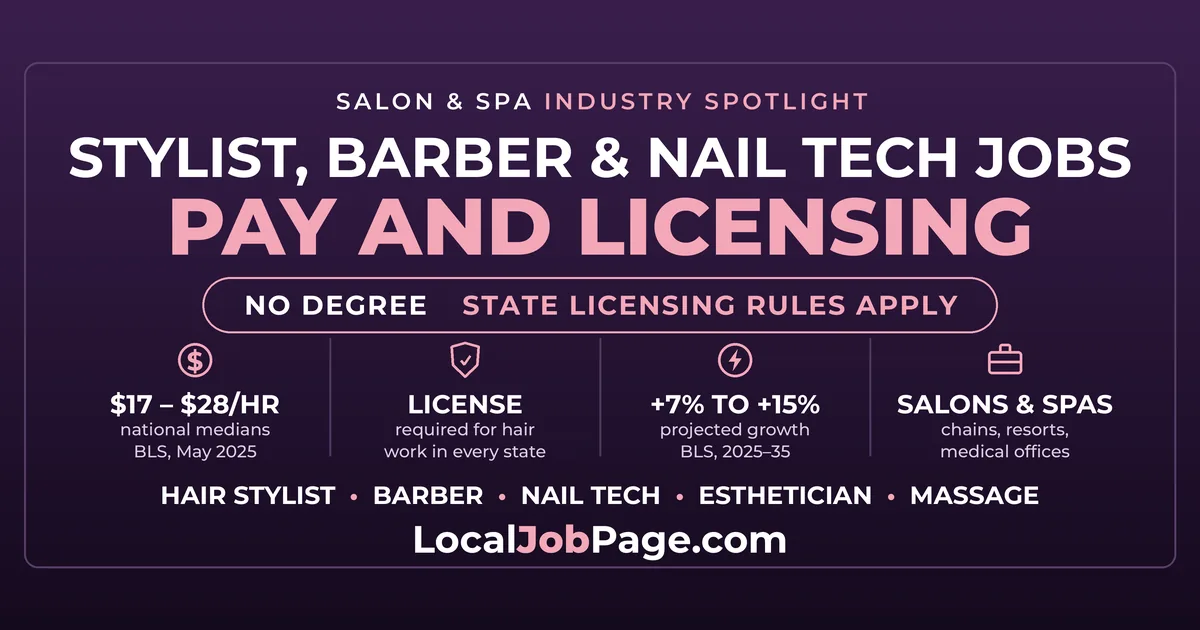
SALON & SPA JOBS — Hair stylist, barber, nail tech and esthetician jobs are some of the few careers you can train for in months instead of years, and the Bureau of Labor Statistics projects all four to grow much faster than average through 2035. The catch is the license: every state requires one for hair work, and the rules change at the state line.
Five salon and spa occupations, one common entry point: a state-approved program and a state exam, with national median pay running from about $17 to $28 an hour.
Need work now? Skip straight to the job links and begin searching now →
💼 The Jobs
Hairstylists and cosmetologists cut, color, style and treat hair, and many also handle basic skin and nail services, depending on what their state license covers. The work is on your feet, appointment-driven and busiest on evenings and weekends.
Barbers focus on cutting, fading, shaving and beard work. It is the most self-employed job in this group: BLS counts 80 percent of barbers as self-employed, whether they own a shop or rent a chair in one.
Manicurists and pedicurists, usually called nail techs, clean, shape and finish fingernails and toenails and apply gels, acrylics and nail art. Depending on the state, nail techs train in a dedicated nail technology program or through a cosmetology program.
Skincare specialists, or estheticians, give facials, waxing, peels and makeup application. They work in day spas, resort spas and medical settings such as physicians' offices.
Massage therapists are licensed separately from cosmetology, but they work in many of the same spas and resorts, and the path in looks similar: an approved program, an exam, a credential.
Not licensed yet? Salons and spas also hire front-desk coordinators, shampoo assistants and retail associates. Those roles are a common way to learn how a busy salon runs while you're in school, though what an unlicensed assistant may legally do varies by state.
💵 What It Pays
These are national medians from the Bureau of Labor Statistics for May 2025, drawn from its Occupational Outlook Handbook, meaning half of workers in each job earned less and half earned more. BLS notes that tips are included in the hair-care wage data. BLS wage estimates cover employees on a payroll, not the self-employed, which matters in a field where so many people work for themselves.
| Job | Median pay, May 2025 | Lowest 10% / highest 10% |
| Massage therapists | $28.10/hr ($58,450/yr) | under $33,640 / over $100,200 a year |
| Skincare specialists | $21.79/hr ($45,330/yr) | under $14.22 / over $39.45 an hour |
| Barbers | $18.37/hr | under $13.75 / over $36.76 an hour |
| Hairdressers, hairstylists and cosmetologists | $17.21/hr | under $13.00 / over $34.23 an hour |
| Manicurists and pedicurists | $17.19/hr ($35,760/yr) | under $13.90 / over $24.10 an hour |
The spread is the story. For hairstylists, the top 10 percent earned about twice the median, and a new stylist still building a book of clients usually starts closer to the bottom. Where you work matters too. BLS reports that estheticians in physicians' offices had a median of $24.81 an hour in May 2025, against $21.10 in salons and spas, and that hairdressers in personal care services out-earned those in retail stores, $17.39 to $14.84.
🎓 Training and Credentials
All five jobs list a postsecondary nondegree award as the typical entry credential, which in practice means a certificate from a state-approved school, not a college degree. The general path:
- Finish an approved program. Cosmetology, barbering, nail technology, esthetics and massage each have their own programs. Required hours are set by each state, so the length depends on where you plan to work. BLS says massage programs can take several months or longer, depending on the program.
- Pass the state exam. For hair, BLS says it usually includes a written test and sometimes a practical or oral exam.
- Meet the basic requirements. Most states set a minimum age, often 16 or 18, and many require a high school diploma or equivalent.
- Keep it current. Licenses carry fees, and some states require continuing education to renew.
Two details are worth knowing before you pick a school. Some states credit cosmetology training toward a barber license, and a few combine the two. And some states have reciprocity agreements, so a licensed stylist may be able to move without retraining. Check your state's cosmetology or barber board before you enroll, because that board, not the school, decides what counts.
🔥 Who's Hiring
Most stylists work in salons and barbershops or for themselves, but the field also has large employers. Franchise haircut chains such as Great Clips and Sport Clips, salons inside beauty retailers such as Ulta Beauty, spa franchises, hotel and resort spas, and dermatology and med-spa practices all hire licensed staff. A chain can be an easier first job out of school because it brings its own customer flow, while an independent salon may offer more room to build a personal clientele.
Demand is steady. BLS projects about 80,300 openings a year for barbers, hairstylists and cosmetologists, about 21,900 for nail techs, about 20,400 for massage therapists and about 14,200 for skincare specialists, on average, over the 2025–35 decade. Many of those openings come from replacing people who change careers or retire.
⚠️ Who This Field Is Not For
If you need a paycheck next week, the license is the barrier: you cannot legally cut hair for pay in any state without one. Expect to stand most of the day, handle chemicals in gloves, and work Saturdays and evenings, because that is when clients come in. And if you want a steady salary from day one, know that many salon jobs pay commission or a mix of hourly pay and commission, plus tips, and booth renters pay the salon for their chair instead of drawing a wage. Ask exactly how pay works before you accept.
🔎 Where to Aim Right Now
Search by the job title you'll hold, plus the chains that hire new graduates. Front-desk and assistant searches are worth running while you're still in school.
Start here:
- Hair stylist jobs
- Cosmetologist jobs
- Barber jobs
- Nail technician jobs
- Esthetician jobs
- Massage therapist jobs
- Salon receptionist jobs
- Great Clips jobs
- Ulta Beauty jobs
🗺️ Where to Look in Your City
Salons go where people are, so these are the network's largest markets, plus Las Vegas and Miami, where resort spas add skincare and massage roles.
- Hair stylist jobs in New York
- Hair stylist jobs in Los Angeles
- Barber jobs in Chicago
- Cosmetologist jobs in Houston
- Hair stylist jobs in Dallas
- Barber jobs in Atlanta
- Nail technician jobs in Phoenix
- Barber jobs in Philadelphia
- Esthetician jobs in Miami
- Massage therapist jobs in Las Vegas
Not on the list? Find your city.
Frequently Asked Questions
Do you need a license to be a hair stylist?
Yes. BLS reports that all states require barbers, hairstylists and cosmetologists to be licensed, usually after finishing a state-approved program and passing a state exam.
How much do hair stylists make?
The national median for hairdressers, hairstylists and cosmetologists was $17.21 an hour in May 2025, tips included, according to BLS. The highest-paid 10 percent earned more than $34.23 an hour.
Which salon job pays the most?
Of the five covered here, massage therapists had the highest median, $28.10 an hour in May 2025, followed by skincare specialists at $21.79.
Can I use my license in another state?
Sometimes. Some states have reciprocity agreements that let a licensed worker transfer without more training or testing. Check with the licensing board in the state you're moving to.
What's the difference between a barber and a cosmetologist license?
Barber licenses center on cutting, shaving and beard work; cosmetology licenses usually cover a wider range of hair, skin and nail services. Some states credit one toward the other, and a few combine them.
Can I work in a salon before I'm licensed?
Often, yes, in roles such as front desk, retail or shampoo assistant. What an unlicensed assistant may do is set by each state, so ask the salon and check the state board's rules.
Find Your Chair
Create a free profile and you'll be ready to apply the day your license comes through. Sign up as a job seeker or browse all jobs.
Employers: Hiring stylists, barbers, nail techs or front-desk staff? Post your openings on LocalJobPage.
Related Reading
- Retail Jobs: What They Pay and Which Ones Lead Somewhere
- Hotel Jobs: What They Pay and How to Get Hired
- How to Write a Resume With No Work Experience
- How to Negotiate a Job Offer, Even for an Hourly Job
Pick the license your state requires before you pick the school, and the rest of the path gets much simpler.